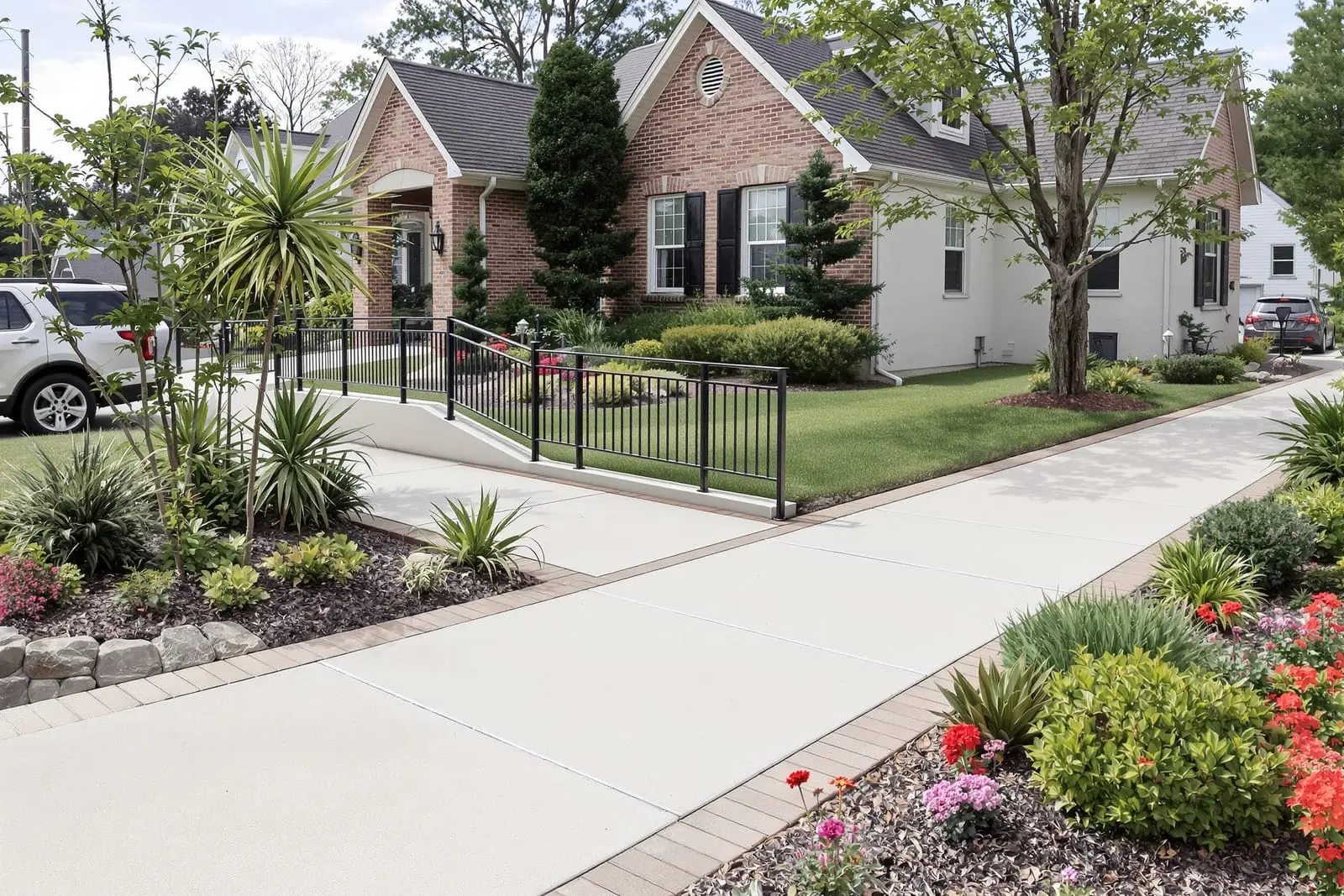
Primetime Concrete Austin provides commercial sidewalk installation in Austin, TX to keep your property safe and accessible. We pour walkways, ADA compliant ramps, and landings that meet slope and clearance requirements. Our concrete surfaces guide visitors smoothly from parking areas to entrances.
Primetime Concrete Austin provides professional commercial sidewalk installation throughout Austin, TX and the surrounding area. Our licensed, insured crew delivers safe, clean, on-time work with a free estimate before anything begins. Call (737) 271-7931 or request your free quote.
Commercial Sidewalk Installation & ADA Ramps in Austin, TX
Primetime Concrete Austin designs and installs commercial sidewalks and ADA ramps that hold up to Austin traffic, heat, and occasional flooding. We focus on code compliance, long-term durability, and clean, professional appearance for your property.
We work with property managers, general contractors, retail centers, medical offices, schools, and industrial facilities throughout the Austin area. Whether you need new construction, infill between existing structures, or demo and replacement of failing walkways and noncompliant ramps, we can handle the full scope, including layout, forming, pouring, and finishing.
Our crews know local conditions around Austin, from expansive clays in Pflugerville to tight infill sites downtown. That experience affects how we choose base depth, slab thickness, and joints so your walks stay level and safe instead of settling, cracking, or collecting water.
How We Build Long Lasting Commercial Sidewalks
Every commercial sidewalk installation starts with site evaluation and layout. We check grades, existing elevations at doors and parking, drainage paths, and utilities. For Austin properties, we pay special attention to how water moves during heavy storms so sidewalk alignment does not trap runoff or cause ponding.
Next, we handle demolition if needed, including sawcutting and removing old concrete or asphalt and hauling it to an appropriate recycling facility. We then excavate to the required depth and compact the subgrade using plate compactors or rollers. In many Austin soils, we recommend 4 to 6 inches of compacted base material such as crushed limestone road base to reduce movement as clay soils swell and shrink.
For commercial sidewalks we typically pour 4 inches of 3000 to 4000 psi concrete, or 5+ inches in areas with heavier cart or light vehicle traffic. We set forms with a slight cross slope to direct water away from buildings and toward landscaping or inlets. Control joints are cut or tooled at calculated intervals to manage cracking, and expansion joints are placed at fixed structures like building slabs and columns.
Finishing is critical for safety. We commonly use a broom finish for slip resistance, then edge and joint the slab for a clean line. In higher profile areas like office plazas or multifamily entrances, we can upgrade to decorative options such as colored concrete or borders, while still keeping the walking surface practical and compliant.
ADA Compliant Ramps, Crosswalks, and Transitions
ADA ramps and compliant walkways are more than just a slope. Primetime Concrete Austin carefully checks local code and ADA requirements for each project, including slope, landings, width, handrail needs, cross slope, and detectable warnings.
For a typical curb ramp from a parking lot to a sidewalk, we verify that the running slope stays within the 1:12 maximum and that there are level landings at the top and bottom where required. Cross slope is kept very low so wheelchairs and walkers do not pull to one side. We coordinate elevations with asphalt paving crews or existing pavements so there are no toe stubs or abrupt lips.
Detectable warning surfaces at street crossings or parking interfaces are installed per ADA and local standards. We typically use cast in place truncated dome panels set into fresh concrete, sized and placed so the pattern starts and ends in the right locations, not just centered randomly. In high heat Austin summers we choose materials and colors that resist fading and warping.
We also build longer accessible routes from parking to entries, including switchback ramps with intermediate landings if height differences are significant. Our layouts try to balance the code requirements with practical use so paths are intuitive for visitors and do not create tight turns that are difficult for wheelchairs.
Design Options, Layout Challenges, and Local Considerations
Austin commercial sites often have limited space and challenging grades. We regularly work on infill projects where we must create compliant slopes within tight property lines, match existing door thresholds, and still move stormwater away from buildings.
When we plan commercial sidewalk installation, we review drainage, accessible routes, and heavy use areas together. For example, at a busy retail center, we may widen sidewalks near main entries, add staging pads for deliveries, and thicken the slab at dumpster enclosures or loading zones where carts and trolleys concentrate loads.
Material options include standard gray concrete, integrally colored mixes, seeded aggregate for upscale plazas, or textured bands to help guide pedestrian movement. Around office buildings and multifamily properties, we sometimes separate a smooth band near the building for strollers and wheelchairs from a more decorative perimeter closer to landscaping.
We also consider Austin specific issues such as tree roots along streets and in older neighborhoods. On tree lined sidewalks we may alter joint spacing, provide root barriers where practical, or slightly shift alignments to avoid known root zones, all to reduce future lifting and trip hazards.
What Drives Cost for Commercial Sidewalks & ADA Ramps
Project cost for commercial sidewalks and ADA ramps in Austin is driven by several key factors: site access, thickness, base requirements, slope complexity, and the amount of demo or utility work involved.
Sidewalks that are easy to access with ready mix trucks, have straightforward grading, and use standard 4 inch concrete over moderate base typically cost less per square foot. Costs rise when we need thicker sections for heavy use, extended ramps with landings, complex forming around columns or planters, or night and weekend work at busy retail centers.
Demolition and haul off is another variable. Old reinforced slabs, thick drive approaches, or mixed asphalt and concrete surfaces take more time and equipment to remove. Urban Austin locations with limited staging space and tricky truck access can also affect production rates.
Finishing details influence pricing as well. Broom finish and standard sawcut joints are the most economical. Upgrades such as colored concrete, decorative scoring, integral borders, or extensive curb and ramp detailing add labor and materials. We walk clients through options so they can match performance and aesthetics to their budget without sacrificing safety or compliance.
Common Problems We Fix and How We Prevent Them
A large part of our work at Primetime Concrete Austin is tearing out and replacing sidewalks and ramps that failed early or never met ADA standards in the first place. We see the same issues repeatedly: standing water on walks, slopes that are too steep, lifted panels from tree roots, and cracked edges at curb ramps.
To prevent ponding, we set clear slope targets during layout and verify them during forming. Our crews use laser levels and digital levels, not just string lines, to check elevation. Where the existing site makes perfect drainage impossible, we plan for trench drains or inlets at low spots and coordinate with other trades.
For cracking and edge failures, we focus on base preparation and joint layout. Austin clays expand and contract significantly. A well compacted granular base and proper joint spacing let the slab move in a controlled pattern. At curb ramps we reinforce critical edges and ensure full support where asphalt parking lots meet the concrete so the transitions do not crumble under vehicle tires.
ADA problems usually come from rushed or unplanned work rather than intentional shortcuts. We measure slopes as we build, not just after the pour, then make adjustments while the concrete is still workable. If we inherit a partially built or noncompliant ramp, we can evaluate whether grinding, overlays, or full replacement are needed to bring it into compliance with the most cost effective solution.
What to Know Before Hiring a Concrete Contractor in Austin
When you hire a contractor for commercial sidewalk installation or ADA ramps in Austin, you are taking on liability for trip hazards and accessibility compliance. It is important to choose a team that understands codes and has real experience with commercial projects, not just residential driveways.
Ask to see recent local jobs that include ramps, curb transitions, and crosswalk tie ins, not only flat sidewalks. Confirm that the contractor will handle layout with a focus on ADA routes and drainage, and that they use written pour plans or markups, especially on complex sites with multiple access points.
Verify that proposed sidewalk thickness, base depth, and concrete strength match expected use. For example, a medical office with constant wheelchair traffic and deliveries needs higher durability standards than a light use landscape path. Ask for details on expansion joints, sawcut timing, and curing methods so you know how they are protecting your investment.
Primetime Concrete Austin provides clear scopes, phasing plans to minimize disruption to your tenants or customers, and scheduled inspections of forms and slopes before every pour. If you are planning a project anywhere in the Austin area, from Round Rock to Buda, we can review your site plan or walk the property with you and outline practical options that fit your budget, schedule, and compliance needs.
“
Professional commercial sidewalks & ada ramps, done right the first time, quality materials, honest pricing, and results that last.
Primetime Concrete Austin
Commercial Sidewalks & ADA Ramps Across Our Service Area