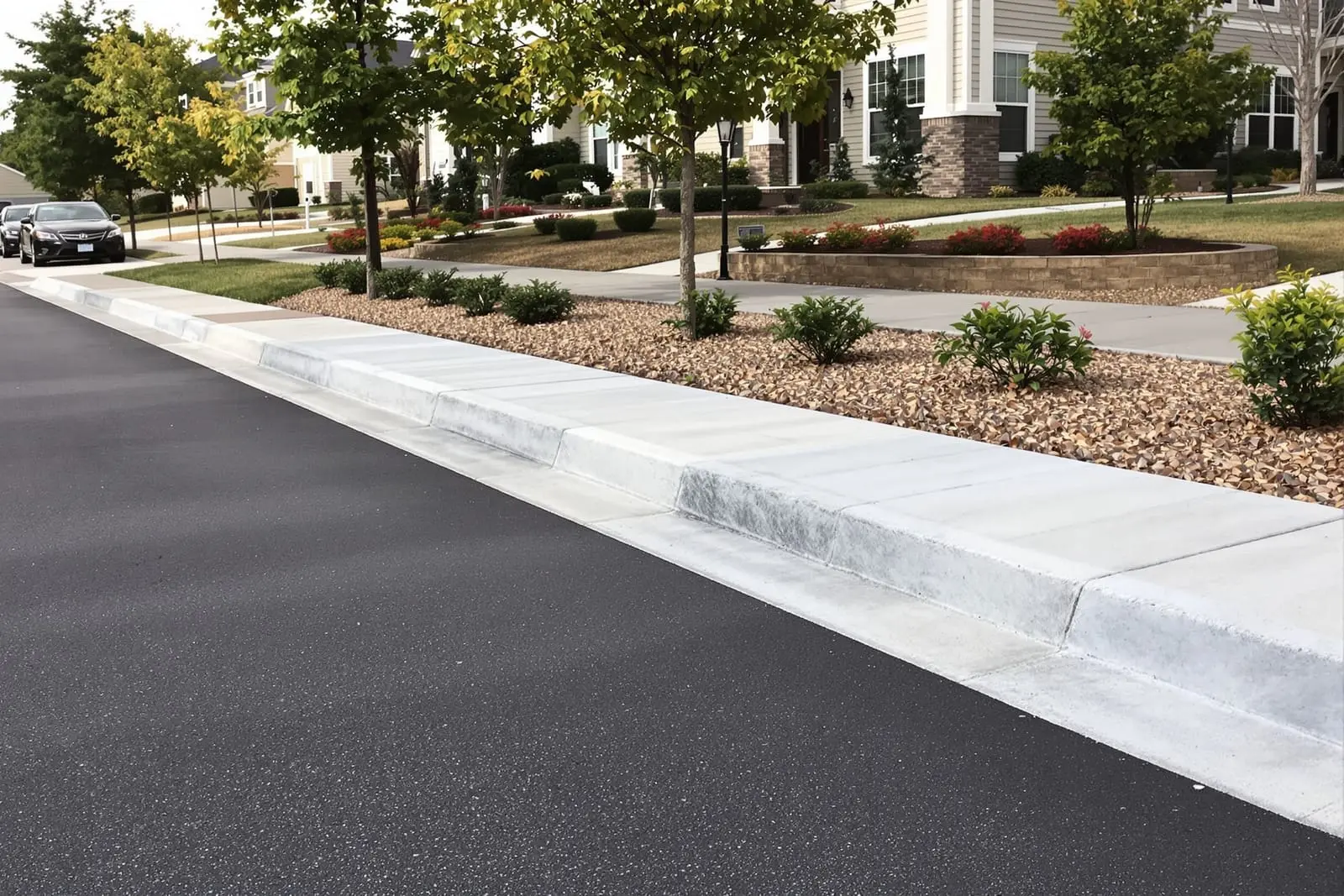
Primetime Concrete Austin installs concrete curb and gutter in Austin, TX to control traffic and water on commercial sites. We form and pour curbs, gutters, and barriers that define parking areas and guide runoff. Properly sloped gutters and transitions help protect your pavement and landscaping.
Primetime Concrete Austin provides professional concrete curb and gutter throughout Austin, TX and the surrounding area. Our licensed, insured crew delivers safe, clean, on-time work with a free estimate before anything begins. Call (737) 271-7931 or request your free quote.
Concrete Curbs, Gutters & Barriers for Austin Properties
Curbs, gutters, and concrete barriers are not just edges and dividers. In Austin they control how stormwater moves, protect pavement from breaking apart, and keep cars and people where they belong. At Primetime Concrete Austin we install and repair concrete curb and gutter systems and traffic barriers that fit Central Texas soils, sudden downpours, and heavy local traffic.
Most residential and light commercial curb and gutter work in Austin uses a standard 3,000 to 4,000 psi concrete mix with air entrainment for durability. For higher traffic streets, apartment complexes, or warehouse yards, we often bump to 4,500 psi and add reinforcing steel or fiber. Barrier work near loading docks, gas stations, or fleet parking may use a higher strength mix and extra steel because of frequent impact.
Local knowledge matters here. Our clay-heavy soils expand and contract between wet springs and hot dry summers. If curbs and gutters are poured too thin, without proper base or with the wrong joints, they crack, tilt, and separate from the pavement in a few seasons. Primetime Concrete Austin designs each run of concrete curb and gutter with Austin drainage patterns, soil behavior, and actual traffic use in mind, not just a one-size-fits-all spec sheet.
How We Build a Reliable Concrete Curb and Gutter in Austin
Every project starts with layout and drainage planning. We look at how water currently flows, where it pools after a storm, and where you want it to go. We shoot grades with a laser level to set a consistent slope toward inlets, swales, or designated discharge points. For most Austin parking lots a slope of about 0.5 to 1 percent works well. Too flat and water sits, too steep and it erodes landscaping or washes debris into the street.
After layout, we cut and excavate the trench. For new work, we strip organic material and soft soil until we reach firm native ground or compacted fill. A typical curb and gutter section might need 6 to 8 inches of compacted base under the gutter pan, and at least 4 inches beneath the curb portion. In many Austin neighborhoods we use crushed limestone base that matches local road specs, then compact it in thin lifts to reach proper density.
Formwork comes next. We set forms for the face, back, and top of the curb and the edge of the gutter pan. On small to mid-size projects, this is usually done with wood or steel forms pinned at tight intervals so the curb line stays straight and the reveal above the pavement is uniform. For long city or commercial runs we sometimes use a slipform method when access allows.
We then place reinforcement where it makes sense. For simple residential curbs that see mostly light vehicles, fiber mesh in the concrete is often enough. For commercial drive lanes, dumpster enclosures, and loading areas, we tie steel rebar in the curb and at the back of the gutter to resist turning and heavy loads. Primetime Concrete Austin always considers truck routes and dumpster locations, because these are the spots that fail first if they are not built for it.
Concrete is placed, vibrated along the forms, struck off, and then we shape the curb face and gutter with specialized curb tools. We cut or tool control joints at set intervals, often 10 feet on center for standard sections, to control cracking. After finishing, we start curing right away, either with a curing compound or by keeping the surface moist, so the concrete reaches its intended strength and resists surface dusting and early cracking.
Curbs, Gutters & Concrete Barriers: Design Choices and Cost Factors
The look and performance of a concrete curb and gutter system comes down to a few key design decisions. Height and shape matter for both function and appearance. Higher curbs are better at holding back landscaping and keeping cars out of walkways, but they are not ideal next to accessible routes. We often mix standard barrier-style curbs at parking lot edges with low-profile or roll-over curbs near drive entries to keep things comfortable for drivers and compliant with accessibility guidelines.
Gutter width and thickness depend on how much water and traffic they will see. In Austin, where intense storms are common, a wider gutter pan can keep water out of travel lanes and away from building slabs. Near building entrances we may use a thicker gutter and reinforce it to prevent cracking from constant turning and braking. In loading docks and drive-thrus, we sometimes design a thicker back-of-curb or integrate the curb with a concrete apron.
Barriers are another layer of protection. For many properties, a simple cast-in-place concrete barrier or wheel stop is enough to keep vehicles from bumping into fences, HVAC equipment, or light poles. For higher impact zones, such as fleet parking or drive aisles near pedestrian areas, Primetime Concrete Austin can install reinforced concrete barriers or integrate them with footings for bollards. The right choice depends on vehicle size, turning space, and how often the barrier might be hit, not just appearance.
Costs are driven by access, length of curb or barrier, base preparation, reinforcement levels, and any tie-ins with existing pavement or drainage structures. Tight sites behind existing buildings, tree roots that must be protected, or removal of thick old concrete will affect price more than the concrete mix itself. We give itemized estimates so you can see what portion of the cost is demo, base work, forming, concrete, and finishes, instead of a single mystery number.
Different parts of Austin also bring different permitting and inspection requirements. Inside city limits, some curb and gutter replacements along public streets may need coordination with the City of Austin so the work matches current right-of-way standards. For private lots, there is usually more flexibility, but fire lane, ADA, and drainage rules still apply. We walk you through which rules matter for your specific property so the finished work passes inspection and actually functions during the next big storm.
Common Problems With Curbs, Gutters & Barriers in Austin (and How We Fix Them)
Most calls we get about concrete curb and gutter work are not from people starting from scratch. They are from owners dealing with specific failures: ponding water, broken curbs at dumpster pads, roots pushing up sections, or barriers that vehicles have knocked out of place.
Standing water is one of the most common issues. It can be caused by poor original slope, settling base, or patches that were added without checking grade. Instead of just patching the low spot, Primetime Concrete Austin checks slope over a longer run so water is actually carried away. Sometimes the solution is grinding a high spot, sometimes it requires removing a longer section and re-pouring with corrected elevations.
Cracked or tilted curbs near trash enclosures, drive entries, and heavy truck paths are another frequent problem. These failures usually come from thin sections, no reinforcement, poor base, or mismatched tie-ins where asphalt meets concrete. Our repairs address the root cause. We excavate deeper, replace weak base, tie new steel into sound concrete where possible, and thicken the curb or gutter where loads concentrate.
Tree root damage is common in older Austin neighborhoods with mature oaks and elms. We coordinate with arborists when needed, and shift alignment slightly or add root barriers when possible, rather than just hacking roots and pouring new concrete over them. This keeps roots from pushing the new curb out of alignment in a few years and protects valuable trees.
For concrete barriers and wheel stops, the main issues are movement, breakage, and misalignment after vehicle impact. Loose barriers are a safety risk. We re-secure or replace them using dowels or anchor systems suited to your base, whether it is asphalt or concrete. Where impact is frequent, we may recommend a continuous poured-in-place barrier tied into the pavement rather than a series of small units that can be easily displaced.
In all repair scenarios, we pay close attention to how the new work transitions to the old. Clean sawcut edges, proper dowels, and consistent joint patterns help keep cracks from jumping into your new sections and protect your investment longer than a quick patch would.
What Austin Property Owners Should Know Before Hiring a Curb & Gutter Contractor
Before you hire anyone to install or repair concrete curb and gutter work in Austin, a few checks can save you money and future headaches. First, make sure they actually talk about drainage and base preparation, not just the visible concrete. If an estimator does not pull a level or discuss where the water will go, the project is at risk.
Ask what concrete strength and reinforcement they recommend for each area of your project. High-traffic paths, fire lanes, and dumpster pads should not be treated the same as a light-use residential edge. At Primetime Concrete Austin we often create separate line items and specs for different areas on the same site, so loading zones, entrances, and quiet parking rows each get what they need without overbuilding everything.
You should also know who is responsible for any required permits or coordination with the City of Austin or local jurisdictions. For work that touches sidewalks, right-of-way, or inlets connected to public systems, the details matter, from curb height to detectable warnings at crossings. A contractor familiar with local standards can help you avoid having to redo non-compliant work.
Timeline and access planning are important. Curb, gutter, and barrier work often crosses driveways and parking aisles that you still need to use. We plan pours in phases, set up temporary access routes when possible, and explain realistic cure times before vehicles can drive on new concrete. In Austin heat, concrete can set quickly at the surface but still needs adequate cure time to gain strength before it sees heavy wheels.
Finally, expect a clear cleanup plan. A professional crew protects adjacent pavement, keeps concrete washout contained, and leaves you with clean joint lines and properly backfilled edges, not piles of broken concrete. When you talk with Primetime Concrete Austin, we walk you through our process in plain terms so you know exactly what will happen from layout to final hose-down, and you can decide with confidence how to move forward with your concrete curb and gutter or barrier project.
“
Professional curbs, gutters & concrete barriers, done right the first time, quality materials, honest pricing, and results that last.
Primetime Concrete Austin
Curbs, Gutters & Concrete Barriers Across Our Service Area