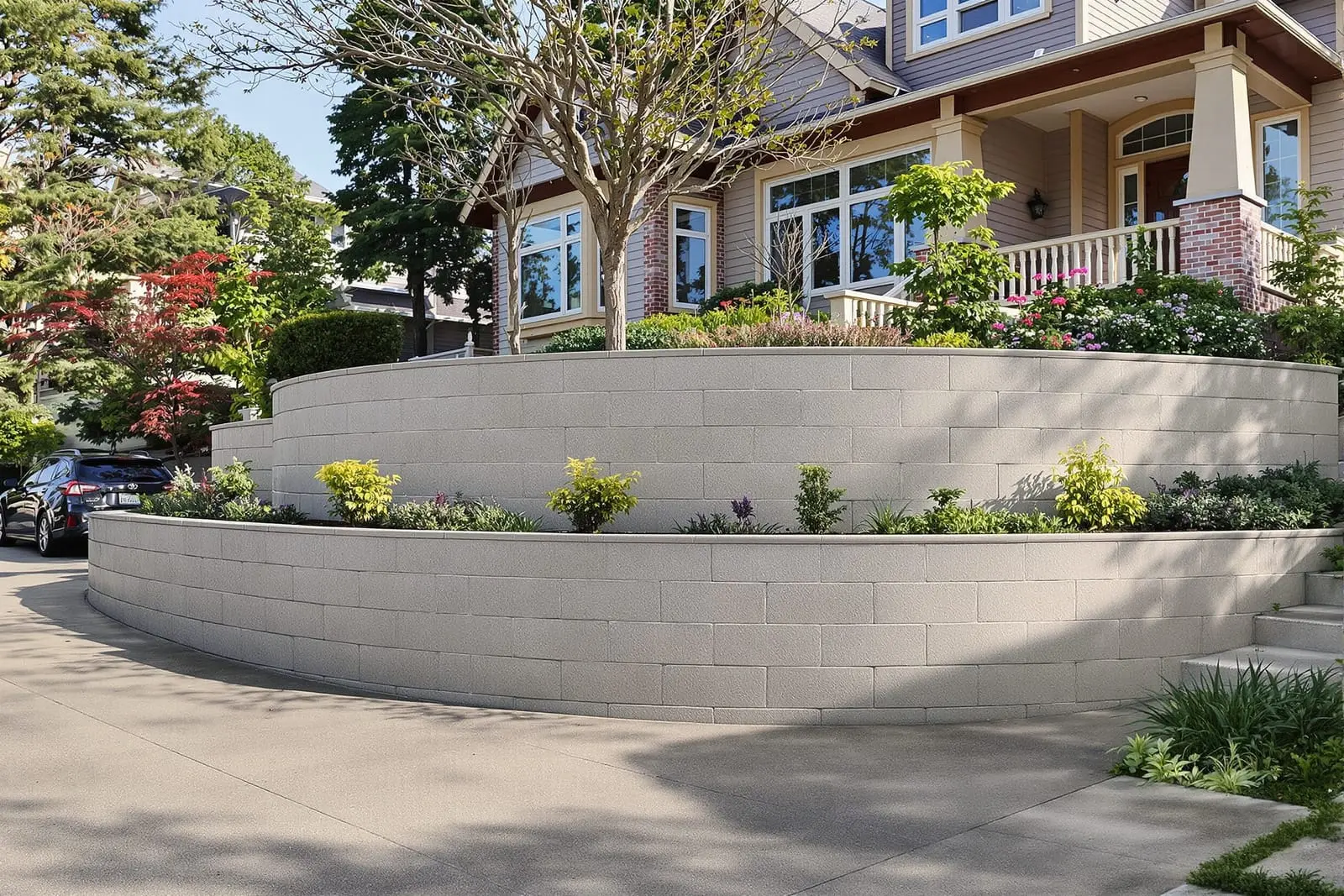
Primetime Concrete Austin builds concrete retaining walls in Austin, TX to manage slopes, support driveways, and define outdoor spaces. We design reinforced walls with proper drainage so they hold back soil safely. Choose plain or decorative finishes that integrate with your landscaping and hardscapes.
Primetime Concrete Austin provides professional concrete retaining wall throughout Austin, TX and the surrounding area. Our licensed, insured crew delivers safe, clean, on-time work with a free estimate before anything begins. Call (737) 271-7931 or request your free quote.
Concrete retaining walls built for Austin hillsides and clay soils
A good concrete retaining wall is not just a row of blocks. It is a structure that has to hold back wet, shifting Texas soil for decades. At Primetime Concrete Austin, we design and build walls around the realities of Travis County soil conditions, not around a generic template.
Most of our retaining wall work is on sloped backyards in neighborhoods like Lakeway, West Lake Hills, Circle C, and older central Austin lots where builders never planned for today’s additions, pools, or patios. We look first at what your wall needs to do. Is it just holding back a small garden terrace, or is it supporting a driveway, parking pad, or pool deck where failure would be serious and expensive?
From there, we decide whether you need a simple gravity wall, a reinforced concrete cantilever wall, or a tiered wall system. For anything over about 3 to 4 feet, we usually pour steel reinforced concrete and design the footing and drainage as a complete system. Shorter landscape walls can sometimes use concrete block cores with rebar and grout fill. We will tell you the difference in cost and lifespan so you can choose based on facts, not sales talk.
Our goal is a wall that fits the slope, your long term plans for the property, and Austin code requirements, not the cheapest thing that will stand up for a few seasons.
How we design and build your concrete retaining wall
Every concrete retaining wall project with Primetime Concrete Austin starts with a site visit. We measure the slope, check soil conditions, and look for nearby structures, big tree roots, and drainage paths. In a lot of Austin yards you have a thin topsoil layer over hard limestone or expansive clay. That affects how deep we can go with footings and where we need to cut or step the wall.
Design steps usually include:
1) Layout and height planning: We stake the wall line, mark the change in grade, and decide whether one tall wall or two shorter terraced walls will work better. On tighter Austin lots with setback limits, terraced walls are often the only code compliant option.
2) Footing design: For poured concrete walls we excavate a footing trench, often 18 to 30 inches deep, or deeper for tall or heavily loaded walls. In areas with soft fill dirt from older construction, we sometimes overdig and replace with compacted base to get down to solid native ground.
3) Reinforcement: We build a rebar cage sized to the height and load of the wall. Typical small residential walls may use #4 or #5 rebar at 12 to 18 inches on center, tied both horizontally and vertically. Taller walls or walls that support driveways may need heavier steel and closer spacing.
4) Forms and pour: We form the wall with straight or curved forms, depending on your design. We then pour a concrete mix with the right strength rating, usually at least 3,000 to 4,000 psi for retaining work, and use vibrators to remove air pockets so the wall is dense and uniform.
5) Curing and finishing: After the pour, we allow the wall to cure properly. Quick backfilling is a common shortcut that leads to cracks. We wait for adequate strength, then install finishes such as smooth trowel, light broom, sandblast, or stone veneer as planned.
Drainage, weep holes, and waterproofing that keep your wall from failing
In Austin, drainage is the difference between a retaining wall that lasts 30 years and one that cracks and leans in 3. Our area gets intense storm bursts, then long dry spells. Clay soils swell and shrink with moisture. If water gets trapped behind a wall, pressure climbs fast.
Primetime Concrete Austin designs every concrete retaining wall with drainage in mind from the start. This usually includes a perforated drain pipe (French drain) at the base of the retained side of the wall, set in washed gravel. The pipe carries water to a safe outlet, often daylighting at the ends of the wall or tying into an existing drainage system if allowed and practical.
We also use free draining backfill where needed. Instead of pushing native clay right against the wall, we often place a gravel zone behind the wall face and separate it from the soil with filter fabric. That keeps fine particles out of the drain pipe and gravel so the system does not clog over time.
Weep holes along the face of taller walls give water a way out during extreme storms. On walls close to living spaces or finished patios, we may also apply a waterproofing membrane on the back of the wall to cut down on seepage and staining.
Common problems we see in older Austin retaining walls are bulging, long horizontal cracks, and rusted exposed rebar. These almost always tie back to missing drains, clogged weep holes, or poor backfill. When we replace or repair a wall, we correct the drainage first so you are not paying for the same problem twice.
Appearance options that match your home and neighborhood
A concrete retaining wall does not have to look like a plain gray barrier. Because Austin homes range from 1950s bungalows in Brentwood to modern builds in Mueller and hillside houses above Lake Austin, we offer finish options that can blend with almost any style.
Basic structural walls can be left as smooth or broom finish concrete, which works well behind fences or in utility areas. For visible areas, many homeowners choose:
• Stained or integrally colored concrete so the wall reads as part of the landscape design.
• Textured or patterned finishes that mimic board formed lines, stone, or subtle ribbing.
• Stone or brick veneer on the exposed face, anchored to the structural concrete. This can tie into existing limestone on the house or other site walls.
On terraced systems, we can build integrated concrete steps and landings so the wall becomes part of a usable pathway instead of just a barrier. Coping at the top of the wall can be simple rounded concrete, precast caps, or a flat top wide enough to sit on.
Primetime Concrete Austin also pays attention to railing and safety where needed. If a wall creates more than a small drop near a walking surface, we can coordinate with you or your fence contractor to embed posts or sleeves in the concrete so railings are solid and clean looking instead of bolted on as an afterthought.
Pricing, permits, and what Austin homeowners should decide up front
Concrete retaining wall cost in Austin depends on several specific factors. Height and length are obvious, but there are other drivers:
• Access: Many hillsides and central Austin backyards have limited access. If equipment has to be smaller or materials must be moved by hand, labor goes up.
• Soil and rock: Digging in solid limestone requires more time and heavier equipment. Digging in deep soft fill requires more excavation and base work so the wall does not settle.
• Loads: A wall that just holds a planting bed is cheaper than a wall that supports a driveway, car, or structure, because engineering, rebar, and concrete volume all increase.
Before we price your job, we look at these conditions on site. For taller or more complex walls, we may recommend or require an engineered design. That adds some upfront cost but can protect you from structural problems and permit issues later.
Inside Austin city limits and many nearby jurisdictions, retaining walls over a certain height, often around 4 feet measured from the bottom of footing to the top of the wall, can require permits and sometimes engineering stamps. Primetime Concrete Austin helps you understand what applies to your property. We can provide drawings and specs for your engineer, and we coordinate with inspectors during the build so there are no surprises.
Before you hire any contractor, you should be clear on:
• The exact wall height ranges, overall length, and location relative to property lines and utilities.
• Whether you plan future additions like a pool, deck, or parking above the wall so it can be designed for that load now.
• How you want the wall to look and how much maintenance you are willing to take on.
We put all of this in writing in our proposal, including clear notes about drainage, reinforcement, finishes, and any required inspections, so you know exactly what you are paying for and how your concrete retaining wall will be built.
“
Professional concrete retaining walls, done right the first time, quality materials, honest pricing, and results that last.