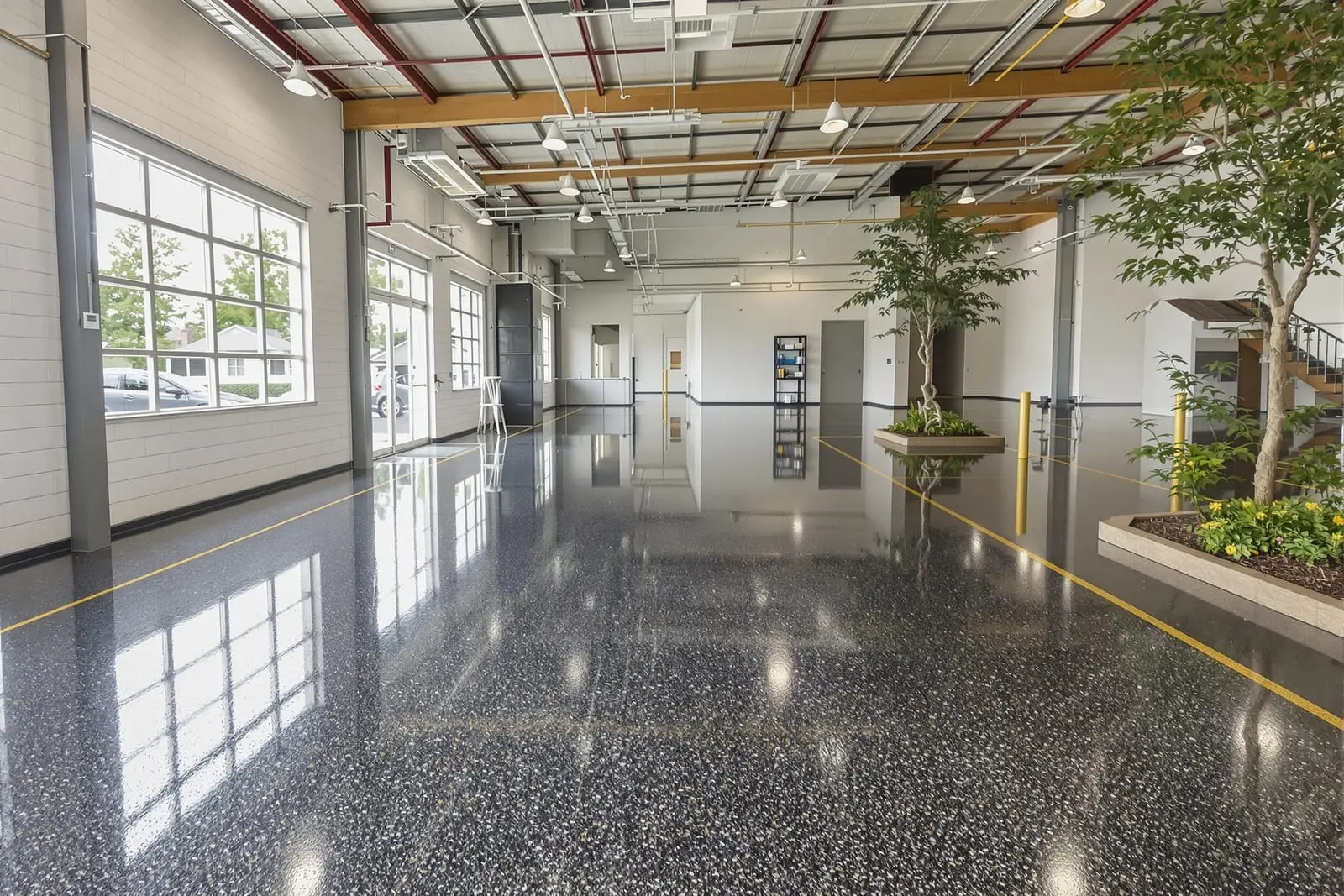
Primetime Concrete Austin installs industrial concrete floors in Austin, TX for warehouses, shops, and distribution centers. We pour high strength slabs with flat surfaces designed for forklifts, racking, and heavy equipment. Our team manages joints, reinforcing, and curing to reduce cracking and long term maintenance issues.
Primetime Concrete Austin provides professional industrial concrete floors throughout Austin, TX and the surrounding area. Our licensed, insured crew delivers safe, clean, on-time work with a free estimate before anything begins. Call (737) 271-7931 or request your free quote.
Industrial Concrete Floors Built For Real-World Warehouse Abuse
Industrial concrete floors in active Austin warehouses do not live in clean brochure photos. Forklifts spin, pallet jacks scrape, contractors drag racks, and summer heat bakes the slab day after day. Primetime Concrete Austin designs warehouse and industrial floors around that reality, not theory.
The first decision is performance class. For light assembly or storage, a standard 4 to 5 inch slab with proper reinforcement may be enough. For heavy racking, constant forklift traffic, or bulk storage, floors often jump to 6 to 8 inches with a higher strength mix and tighter reinforcement layout. We look at your actual equipment loads, rack layout, and traffic patterns in your building (or plans) so we do not underbuild the slab.
Austin soils are another key factor. A lot of local industrial parks sit on expansive clay that shrinks and swells with moisture changes. If we ignore that, you get random cracking, slab curl at doorways, and trip hazards at joints. Primetime Concrete Austin evaluates subgrade conditions, recommends stabilization when needed, and sets joint spacing to control movement where you can live with it, not in the middle of your loading aisle.
How We Build Warehouse & Industrial Concrete Floors, Step By Step
A long lasting industrial floor starts with the subgrade. We begin by scarifying and proof rolling the existing base to find soft spots. Any pumping or rutting under a loaded truck means that area gets undercut and replaced with compacted base material. For many Austin sites, we target at least 4 to 6 inches of compacted crushed limestone base over native soil, more if your geotech report calls for it.
Next is reinforcement and slab design. Depending on your project, we may use rebar mats, post tension cables, or heavy welded wire reinforcement. Rebar is common for smaller warehouses or thickened slabs at dock areas. Post tension slabs can reduce the number of control joints and help keep them tight, which matters when you have narrow aisle forklifts. We review your drawings, racking design, and any engineer of record requirements so what we pour matches structural intent.
Concrete placement on warehouse projects is all about sequence and access. We coordinate pour sizes to match where our crews can place, screed, and finish while the concrete is still workable. On tight Austin infill sites or tenant improvements, that might mean smaller daily pours with concrete pumped in through overhead doors. On new ground up shells, we can schedule large placements to minimize construction joints.
Finishing is timed to your use. For most industrial floors we machine trowel to a hard, dense surface with a specified flatness (FF) and levelness (FL) target. If you have very narrow aisle (VNA) racking or wire guidance, you may need a superflat specification. Primetime Concrete Austin coordinates with your racking vendor and can bring in specialty equipment when required.
Material Options, Joint Details, And Surface Treatments
Not every industrial concrete floor needs the same mix. A typical warehouse may use a 4,000 psi mix, while cold storage, heavy manufacturing, or high rack facilities often push to 4,500 to 5,000 psi. We also consider slump (workability), aggregate size, and admixtures like water reducers or set retarders, especially in hot Austin summers when concrete can flash set if not managed.
Joints are where most warehouse floors fail in real use. Sawcut control joints are added to control shrinkage cracking, and construction joints mark where one day’s pour meets the next. To keep your forklifts from beating themselves up, we detail joints with armored joint systems or heavy duty keyways in high traffic aisles and dock doors. We also use semi rigid epoxy or polyurea joint fillers that support the edge of the slab so forklift wheels do not chip the concrete.
On the surface, you have options that affect both performance and budget. A hard troweled basic industrial finish is the cost effective baseline for many Austin warehouses. For improved abrasion resistance and dust control, we can add a dry shake hardener at placement or apply a chemical densifier after curing, then mechanically polish the slab to your chosen gloss level. If you handle food, pharmaceuticals, or corrosive chemicals, we can prep and install compatible coatings or toppings over the structural slab so you meet hygiene and spill containment requirements.
Slip resistance is another issue. Purely polished surfaces can be slick when wet. If your operations involve frequent washdowns or wet loading docks, we can target a more matte, textured finish or add micro texture in specific zones so you stay safe without dragging down forklift travel everywhere.
What Drives Cost For Industrial Concrete Floors In Austin
For warehouse owners and GC’s, the real question is usually why one bid is so much lower than another. With industrial concrete floors, cost swings are usually tied to thickness, reinforcement, joint detailing, and surface requirements.
Slab thickness and reinforcement are the biggest material drivers. A 6 inch slab with rebar or post tension cables uses significantly more concrete and steel than a 4 inch slab, but sometimes that extra upfront cost prevents repairs around racks and dock doors only a few years later. Primetime Concrete Austin lays out options in plain numbers, including life cycle maintenance implications, not just initial pour cost.
Subgrade preparation is the next major variable. Some North and East Austin sites have reasonably stable base, while other areas, especially on deeper clay, need more excavation and engineered fill. If there is an existing failed slab that needs demo, hauling that concrete and exposing utilities below can add complexity.
Finish level and flatness tolerances also move the needle. A standard machine troweled finish is more affordable than a superflat, tightly toleranced floor that supports very narrow aisles. Polished or hardened surfaces, line striping, and coatings add to the total package but may save you in cleaning and tire wear over time.
Work conditions matter too. Night pours in an active facility, limited access pumping, or strict noise limits in certain Austin industrial parks can slow production and impact labor costs. When we walk your project, we factor all these realities into a detailed proposal so change orders are the exception, not the rule.
Common Warehouse Floor Problems And How We Prevent Them
Most of the service calls we see in older Austin warehouses are not about the concrete being weak. They are about details that were not handled correctly when the slab was poured.
Joint spalling is the number one issue. Forklift wheels hit a slightly misaligned joint over and over until the concrete edge breaks. We address this by aligning load transfer devices correctly, using appropriate joint fillers, and avoiding wide, unprotected joints in main travel paths. If you already have damage, Primetime Concrete Austin can cut and rebuild joints with semi rigid epoxies and patch materials designed for industrial traffic.
Random cracking is another frequent complaint. Some cracking is inevitable as concrete shrinks, but it can be controlled and kept tight. We plan joint spacing for your slab thickness, place cuts within the right time window after finishing, and maintain consistent curing so one area does not dry out faster than another. For slabs on problematic soils, we may recommend thicker base or even collaboration with your engineer on vapor barriers or subslab drainage.
Surface dusting and scaling often show up where curing was rushed or where unsealed industrial floors see constant forklift turning. On new work, we specify proper curing methods, often with curing compounds or wet cure blankets, and recommend densifiers or hardeners when your traffic level calls for it. On existing dusty floors, we can grind, densify, and, if appropriate, polish or coat the surface to lock it down and make it easier to keep clean.
We also watch door thresholds and dock areas carefully, because that is where slab curl and frost heave (in freezer applications) tend to create trip edges. We use proper insulation details, doweled connections, and armored edges as needed so those high abuse zones last.
Permits, Scheduling, And Working Around Your Operations
For new construction or major renovations in Austin, industrial concrete floors are usually part of a larger permitted project. We coordinate with your GC, engineer, and the City of Austin or surrounding jurisdictions so our work aligns with approved plans and inspections. For tenant improvements on existing shells, many slab repairs and replacements can be performed under the umbrella of a general remodel permit. We are familiar with local inspectors and common inspection points related to subgrade compaction, vapor barriers, and reinforcement placement.
If your warehouse is already operating, shutting down completely is often not an option. Primetime Concrete Austin can phase floor work by aisle, quadrant, or dock bay so your team can keep shipping and receiving. We schedule sawcutting, demo, and large pours to avoid your peak operations whenever possible, and we plan cure times so you know exactly when each area will reopen to foot traffic, pallet jacks, and forklifts.
Austin weather also plays a role. High heat, sudden storms, and humidity changes all affect industrial concrete floors. In summer we may adjust pour times to early morning or night, use set control admixtures, and increase manpower so we finish and cure the slab properly before the heat spikes. During wet seasons, we take extra care to protect subgrades from saturation so the base does not pump under load.
Before you hire any industrial concrete contractor, ask for specific project examples in the Austin area that match your slab thickness, rack type, and traffic level, not just generic photos. Primetime Concrete Austin is ready to walk your warehouse, review your plans, and give you a straight answer on what it will take to get an industrial concrete floor that actually holds up in your operation.
“
Professional warehouse & industrial concrete floors, done right the first time, quality materials, honest pricing, and results that last.
Primetime Concrete Austin
Warehouse & Industrial Concrete Floors Across Our Service Area